The Genocide Against the Hutu under the 1948 Genocide Convention
Introduction
Between 1994 and 1997, Hutu civilians were killed in their hundreds of thousands in Rwanda and in Zaire, now the Democratic Republic of the Congo (DRC). The killings were carried out by the Rwandan Patriotic Army (RPA), the army of the Rwandan Patriotic Front (RPF), and by its Congolese ally, the Alliance des Forces Démocratiques pour la Libération du Congo-Zaïre (AFDL). United Nations investigators and leading human rights organisations have documented them in detail. No court has yet ruled on them.
These crimes were genocide. When measured strictly against the statutory requirements of Article 2 of the 1948 Convention on the Prevention and Punishment of the Crime of Genocide, the systematic, widespread campaigns targeting Hutu populations fulfil all legal criteria to be designated as genocide. Article 2 sets three requirements. The victims must belong to a protected group and be targeted as such. One or more of five prohibited acts must have been committed against them. Those acts must have been committed with intent to destroy the group, in whole or in part. This article demonstrates, on the documented record, that each requirement is met.
What happened
From April 1994, as RPF forces took control of Rwanda, their soldiers killed Hutu civilians in large numbers (Des Forges, 1999). After the RPF victory in July 1994, more than a million Rwandans, most of them Hutu civilians, fled to camps in the Kivu provinces of eastern Zaire. In October 1996, the RPA and the AFDL attacked those camps. Many refugees returned to Rwanda. Others fled deeper into Zaire and were hunted for seven months in several directions, through forests, along rivers and towards the borders of the Central African Republic and the Republic of Congo. Massacres took place along these routes, as far as Mbandaka, more than 2,000 kilometres from the Rwandan border (OHCHR, 2010, para. 517). Congolese Hutu were attacked in their own villages. Inside Rwanda, the killing of Hutu civilians continued into 1997 (Amnesty International, 1997a).
The first requirement: a protected group, targeted as such
Article 2 protects national, ethnical, racial and religious groups. The victims must be targeted as such, that is, because of their membership of the group. International tribunals assess membership partly through the eyes of the perpetrators. In Prosecutor v. Jelisić (1999), the International Criminal Tribunal for the former Yugoslavia (ICTY) held that a group is best identified from the point of view of those who single it out from the rest of the community.
The Hutu meet this test. The 2010 Mapping Report of the Office of the High Commissioner for Human Rights (OHCHR) concluded that "the Hutu population in Zaire, including refugees from Rwanda, constituted an ethnic group as defined in the Convention" (OHCHR, 2010, para. 514).
The record also shows that the victims were targeted as Hutu. In Rwanda, the historian Alison Des Forges, writing for Human Rights Watch, found that "virtually all persons killed by RPF forces were Hutu". The great majority of these killings "had apparently not been motivated by any suspicion whatsoever of personal participation by victims" in earlier massacres (Des Forges, 1999). Victims were not selected for anything they had done.
In Zaire, nationality made no difference. In Uvira territory, about two-thirds of the 219,000 refugees in the Ruzizi valley camps were Burundian. The Mapping Report records checkpoints at which "individuals identified as Rwandan or Burundian Hutus" were systematically separated from others and killed (OHCHR, 2010, para. 199). Congolese Hutu were targeted in their own villages. In Rutshuru territory alone, AFDL and RPA units killed at least 350 civilians, "most of them Hutu Banyarwanda", in Rutshuru town centre, several hundred Hutu Banyarwanda at Mugogo market, and up to 600 at Kabaraza in October and November 1996. At Musekera, Hutu Banyarwanda civilians were gathered in the communal office, bound and clubbed to death (OHCHR, 2010, paras 273 to 276).
Rwandan, Burundian and Congolese victims shared no passport, army or political cause. What they shared was Hutu identity. The first requirement is met.
The second requirement: the prohibited acts
Article 2 lists five acts: killing members of the group; causing them serious bodily or mental harm; deliberately inflicting conditions of life calculated to bring about the group's physical destruction; imposing measures to prevent births; and forcibly transferring children to another group. Any one act suffices. The record establishes the first three.
Killing. In Rwanda, Des Forges found that killings of civilians by RPF forces in 1994 "were wide-spread, systematic, and involved large numbers of participants and victims", with "a minimum death toll of 25,000 to 30,000 people" (Des Forges, 1999). In Zaire, the refugee camps were bombarded with heavy weapons: Kibumba and Katale on 25 and 26 October 1996, and Mugunga for six hours on 14 November. At Kibumba alone, local organisations buried more than 4,000 bodies between November 1996 and January 1997 (OHCHR, 2010, paras 213 to 220). As early as January 1997, the UN Special Rapporteur on Zaire reported that the AFDL had attacked refugee camps, "causing large numbers of deaths and displaced persons", and that it "kills rather than takes prisoners" (Garretón, 1997a, paras 199 and 202). Visiting North Kivu in March 1997, he found at Kibumba camp the remains of 37 men, "also bound, who had been shot or killed with axes", and at Kilimanyoka graves holding 46 bodies, some found "naked and blindfolded" with "their hands tied behind their backs". He singled out these cases as ones "where it was quite clear that death was not caused by the war" (Garretón, 1997b, para. 11). The Mapping Report puts the victims of the attacks on Hutu in Zaire at "probably tens of thousands" (OHCHR, 2010, para. 513). By December 1997, the United Nations High Commissioner for Refugees (UNHCR) considered as many as 200,000 Rwandan refugees in the DRC to be unaccounted for, many presumed dead (Amnesty International, 1997b).
Serious bodily or mental harm. The Mapping Report records "a very high number of Hutus shot, raped, burnt or beaten" (OHCHR, 2010, para. 513).
Conditions of life calculated to destroy. Refugees already weakened by hunger and disease were driven into the equatorial forest and denied relief. The UN Secretary-General's Investigative Team found that the AFDL blocked relief organisations from camps holding "large numbers of ill and wounded persons" (United Nations Security Council, 1998, para. 93). It concluded that the massacres and the denial of humanitarian assistance to displaced Rwandan Hutu were "systematic practices involving murder and extermination, which constitute crimes against humanity" (para. 95). One aid organisation told Amnesty International that its "aid and presence" had been used "to lure people from the forest" (Amnesty International, 1997b). In March 1997, refugees from Ubundu sheltering at Lula camp were "dying of hunger", yet UNHCR could not reach them "because the Alliance refused to grant it access" (Garretón, 1997b, para. 36).
The second requirement is met.
The third requirement: intent to destroy the group
Genocide requires a special intent, known in law as dolus specialis. The perpetrators must have intended not merely to kill, but through the killing to destroy the group, in whole or in part. The part targeted must be substantial and may be confined to a geographic area (Prosecutor v. Krstić, 2004). Intent is distinct from motive. Perpetrators driven by revenge or military strategy may still possess genocidal intent (Prosecutor v. Jelisić, 2001, para. 49).
Courts have never required a confession or a written extermination order. Intent may be inferred from facts and circumstances such as the general context, the scale of the atrocities, the systematic targeting of victims because of their membership of the group, and the repetition of destructive and discriminatory acts (Prosecutor v. Jelisić, 2001, para. 47). The International Court of Justice (ICJ) applies a demanding version of this test: genocide must be "the only reasonable inference" from the pattern of conduct (Bosnia and Herzegovina v. Serbia and Montenegro, 2007, para. 373; Croatia v. Serbia, 2015, para. 148). Six features of the record support that inference.
The pursuit. A military operation ends when the threat is neutralised. The campaign in Zaire did not end with the destruction of the border camps. Refugees were hunted for seven months across the breadth of Zaire, in several directions, through forest, along rivers and towards international borders. The Mapping Report calls the Mbandaka and Wendji massacres of 13 May 1997 "the final stage in the hunt for Hutu refugees" (OHCHR, 2010, para. 517).
Entrapment. In Rwanda in 1994, RPF forces killed civilians at meetings so often that Rwandans joked that "kwitaba inama", to attend a meeting, had come to mean "kwitaba Imana", to die (Des Forges, 1999). In Zaire, according to the Mapping Report, "the massacres often began with a trick by elements of the AFDL/APR, who summoned the victims to meetings on the pretext either of discussing their repatriation to Rwanda in the case of the refugees, or of introducing them to the new authorities in the case of Hutus settled in the region, or of distributing food. Afterwards, those present were systematically killed." The Report concluded that "such acts certainly suggest premeditation and a precise methodology" (OHCHR, 2010, para. 515). The UN Special Rapporteur had received reports of the same method in North Kivu: at Bukombo on 31 December 1996, the AFDL "called a meeting and fired on those who attended, killing 300 persons", and at Chanzu 207 people were killed "after being called to a meeting at a church" (Garretón, 1997b, para. 21). Such methods concentrate civilians rather than separate them from combatants.
The sealing of civilian refuges. In October 1997, RPA soldiers attacked displaced civilians sheltering in Nyakimana cave (often rendered Nyakinama), Kanama commune, north-western Rwanda, "with grenades and other explosives" and then "sealed off the entrance with cement and gravel". Local sources estimated 5,000 to 8,000 dead (Amnesty International, 1997a). A sealed cave holds no combatants to be distinguished from civilians.
The identity of the victims. According to the Mapping Report, "the majority of the victims were children, women, elderly people and the sick, who were often undernourished and posed no threat to the attacking forces" (OHCHR, 2010, para. 31). Their killing cannot be explained by military necessity.
Concealment. Human Rights Watch documented systematic efforts in Zaire to clean massacre sites, burn bodies and kill or intimidate witnesses (Human Rights Watch, 1997). In Rwanda, UN officials were told of "a special RPF squad for disposing of bodies by burning them" (Des Forges, 1999). Concealment does not prove genocidal intent on its own. It does show that the killing was organised rather than spontaneous, and that those responsible knew it to be criminal.
Command. Des Forges concluded that the killings in Rwanda were too numerous and too similar to be the work of individual soldiers, and that the army's commanders "must have known of and at least tolerated these practices" (Des Forges, 1999). In July 1997, Paul Kagame, then Rwanda's Vice-President and Minister of Defence, told The Washington Post that Rwandan forces had planned and directed the campaign in Zaire. He named its objectives as destroying the camps, eliminating former army and Interahamwe forces, and overthrowing the Mobutu government (Pomfret, 1997).
The United Nations has reached the same point. The Mapping Report concluded that the attacks in Zaire, "which targeted very large numbers of Rwandan Hutu refugees and members of the Hutu civilian population, resulting in their death, reveal a number of damning elements that, if they were proven before a competent court, could be classified as crimes of genocide" (OHCHR, 2010, para. 515). Describing the final massacres at Mbandaka, it found that the conduct of certain AFDL and RPA elements "seems to equate to 'a manifest pattern of similar conduct directed against that group', from which a court could even deduce the existence of a genocidal plan" (para. 517).
The inference of intent to destroy the Hutu in part is the only one that accounts for the whole record. The third requirement is met.
From documentation to a court: DRC v. Rwanda
The Mapping Report did not treat its conditional language as the last word. It stated that the question "can only be decided by a court decision based on proof beyond all reasonable doubt" (OHCHR, 2010, para. 510). It called for "a full judicial investigation", since "only such an investigation and judicial determination would be in a position to resolve whether these incidents amount to the crime of genocide" (para. 522). That step has now been taken.
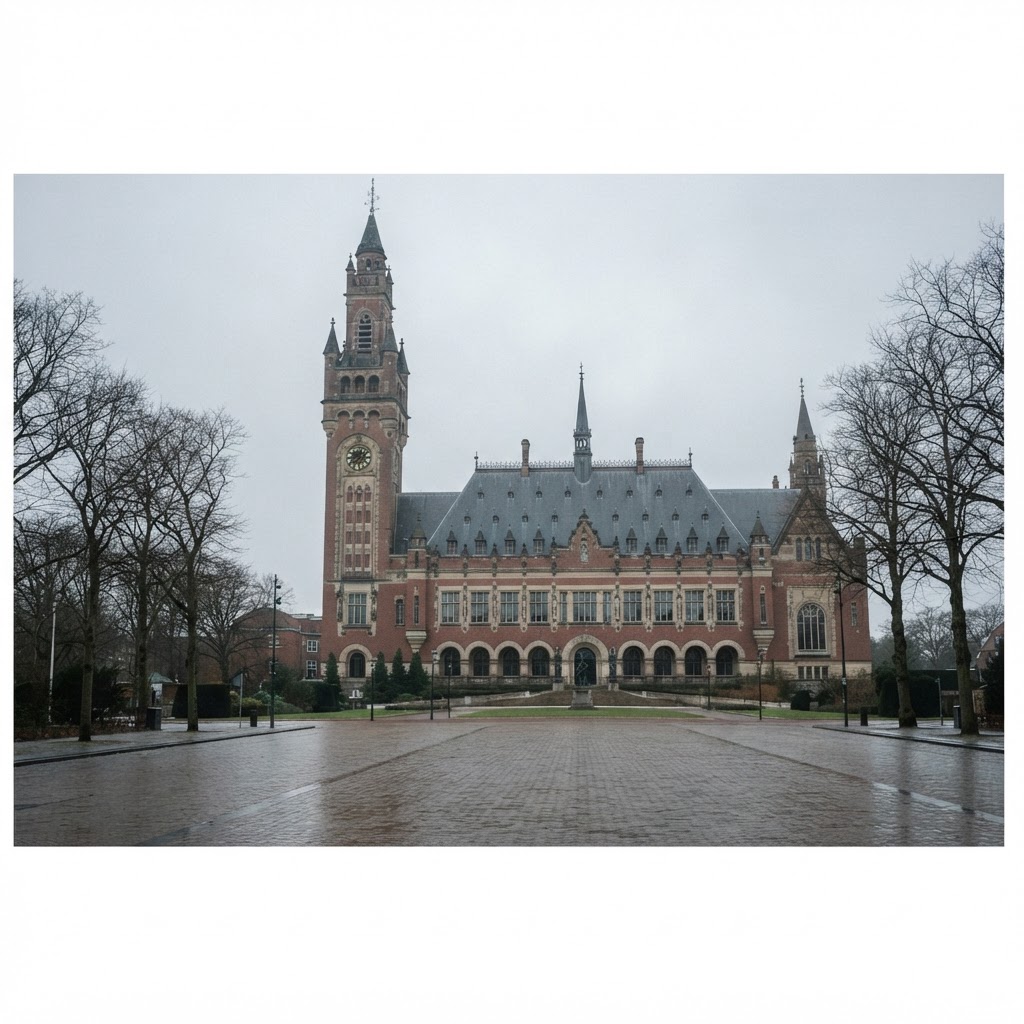
On 26 June 2026, the DRC instituted proceedings against Rwanda before the ICJ. The application invokes the Genocide Convention, among other treaties, for violations "from 1996 until the present day". It names "Rwandan refugee Hutus" among the victims, alleging that the RPA and AFDL massacred them in their tens of thousands (Opinio Juris, 2026). A 2002 application by the DRC was dismissed in 2006 because Rwanda had entered a reservation to Article IX, the clause conferring jurisdiction on the Court. Rwanda withdrew that reservation in December 2008 (Carlson, 2026).
The ICJ does not try individuals. It decides whether a state has breached its duties to refrain from, prevent and punish genocide, and a state can be responsible for genocide committed by its organs or by forces under its effective control (Bosnia and Herzegovina v. Serbia and Montenegro, 2007). A filing remains an allegation, not a judgment, and Rwanda may contest jurisdiction over events before 2008. Even so, the crimes against the Hutu are now formally before the world's highest court.
Why the counter-arguments fail
Counter-insurgency and self-defence. Rwanda has described its intervention as "a matter of survival" (Government of Rwanda, 2010). The camps did hold armed former soldiers and militia who mounted cross-border attacks. Yet motive and intent are distinct in law, and a strategic aim can coexist with the intent to destroy a group (Prosecutor v. Jelisić, 2001, para. 49). Armed elements among the refugees did not suspend the duty to distinguish combatants from civilians. Nor can they explain the killing of children and the sick, the screening of Burundian Hutu at checkpoints, a pursuit to Mbandaka or the sealing of a cave full of families. Where methods are aimed systematically at the group rather than at the threat, a security rationale does not displace genocidal intent.
Partial repatriation. The Mapping Report noted that very large numbers of Hutu were allowed to return to Rwanda, which it said "militate[s] against proving a clear intent to destroy the group" (OHCHR, 2010, para. 32). The record of the returns does not show restraint. South of Kisangani, some 80,000 refugees in the Kasese and Biaro camps were waiting to be repatriated in April 1997. The Rwandan government opposed the planned airlift and insisted on return by road. Aid workers were barred from the camps on 21 April. The next day, AFDL and RPA units attacked both camps, killing at least 200 refugees at Kasese and around 100 at Biaro, including women and children (OHCHR, 2010, paras 245 to 247). The airlift that eventually carried nearly 40,000 refugees home by the end of May was organised by UNHCR, not by the forces pursuing them (U.S. Committee for Refugees, 1998). Return of this kind, under fire and as the only escape from death, is not evidence of an intent to spare. But Article 2 requires intent to destroy a group only "in part", as the Report itself accepted. In Krstić, the ICTY Appeals Chamber found genocide at Srebrenica although the women, children and elderly were transported out of the enclave. The survival of some did not erase the destruction of others. Likewise, the return of some refugees cannot cleanse the intent behind the killing of those who remained in Zaire and were hunted across it.
The standard of proof. The strongest objection is legal. If genocide must be "the only reasonable inference" (Croatia v. Serbia, 2015, para. 148), critics argue that reprisal or counter-insurgency remain plausible alternatives. The Mapping Report also noted that early in the war, in some places, women and children were separated and only men were killed (OHCHR, 2010, para. 521). The answer lies in the totality of the record. Isolated incidents may admit other explanations. The combination of ethnic screening, entrapment, denial of aid, concealment and a 2,000-kilometre pursuit of non-combatants across three nationalities does not. The absence of a court ruling proves only that no court had yet been asked.
Conclusion
The crimes committed against the Hutu meet every requirement of Article 2. The victims belonged to a protected ethnic group and were targeted as Hutu, whether Rwandan, Burundian or Congolese. They were killed, seriously harmed and subjected to conditions of life calculated to destroy them. The intent to destroy the group in part is the only inference that explains the whole record, from the meetings turned into massacres in Rwanda to the final killings at Mbandaka. These crimes were genocide.
For three decades, this conclusion was kept out of every courtroom. It is now before the International Court of Justice. The law has always been clear. What has been missing is the will to apply it to these victims.
Reference list
- Amnesty International (1997a) Rwanda: civilians trapped in armed conflict. AFR 47/43/97.
- Amnesty International (1997b) Democratic Republic of Congo: deadly alliances in Congolese forests. AFR 62/33/97.
- Bosnia and Herzegovina v. Serbia and Montenegro (2007) ICJ Reports 2007, p. 43.
- Croatia v. Serbia (2015) ICJ Reports 2015, p. 3.
- Carlson, K.B. (2026) DR Congo has taken Rwanda to the world court over genocide again. The Conversation, 13 July.
- Des Forges, A. (1999) Leave none to tell the story: genocide in Rwanda. New York: Human Rights Watch.
- Garretón, R. (1997a) Report on the situation of human rights in Zaire. E/CN.4/1997/6, 28 January.
- Garretón, R. (1997b) Report on the situation of human rights in Zaire, Addendum. E/CN.4/1997/6/Add.2, 2 April.
- Government of Rwanda (2010) Official comments on the draft UN Mapping Report on the DRC. Kigali.
- Human Rights Watch (1997) What Kabila is hiding: civilian killings and impunity in Congo. New York.
- Human Rights Watch (2010) DR Congo: Q and A on the UN human rights mapping report, 1 October.
- OHCHR (2010) Report of the mapping exercise documenting the most serious violations of human rights and international humanitarian law in the DRC, March 1993 to June 2003. Geneva.
- Opinio Juris (2026) A new Genocide Convention case in the ICJ: DRC v Rwanda version 3.0, 7 September.
- Pomfret, J. (1997) Rwandans led revolt in Congo. The Washington Post, 9 July.
- Prosecutor v. Jelisić (1999) IT-95-10-T, Trial Chamber Judgment, 14 December.
- Prosecutor v. Jelisić (2001) IT-95-10-A, Appeals Chamber Judgment, 5 July.
- Prosecutor v. Krstić (2004) IT-98-33-A, Appeals Chamber Judgment, 19 April.
- United Nations (1948) Convention on the Prevention and Punishment of the Crime of Genocide, 9 December, UNTS 78, p. 277.
- United Nations Security Council (1998) Report of the Secretary-General's Investigative Team, S/1998/581, 29 June.
- U.S. Committee for Refugees (1998) World refugee survey 1998: Zaire. Washington, DC.